Why AI Gains Hit a Ceiling Outside Engineering

Ask around and you hear the same story with different details. A wall of pilots, a few prototypes somebody is proud of, a center of excellence that meets on Thursdays, and a token bill that goes up every quarter. When the CFO asks what came back, a lot of teams point at the same three-month low-hanging fruit they were pointing at in 2023.
The numbers say roughly the same thing. MIT's NANDA group put out a report in mid-2025 saying about 95 percent of the enterprise generative AI efforts they looked at had no measurable P&L return. The sample was small and self-reported, so I hold that one loosely. BCG surveyed around 1,250 companies the same year and found about 5 percent getting value from AI at scale and 60 percent getting nothing material. McKinsey's 2025 survey put AI high performers at about 6 percent of respondents, and one of the biggest things separating them was that they were nearly three times as likely to have fundamentally redesigned how the work gets done.
Three firms, three methods, and they land in about the same place. A small group is pulling away and most everyone else is in some version of organized chaos.
Six percent is tiny, and I'd read the workflow finding carefully. Redesigning workflows around automation has always paid. RPA has been producing value for well over a decade by scripting the steps a person used to click through. If what the top 6 percent are mostly doing is a smarter version of that, it's better RPA, and I'd expect it to flatten out where RPA did, on the work that was already structured enough to script. The work that isn't structured that way is most of what a knowledge business does, and that's where the money is.
Why software engineering works and the rest of the org stalls
The clearest AI success story so far is software engineering, and I think it's worth asking why. My read is that the value in software is already code native. The work product is text, it's versioned, it sits in a repository, there's a test suite that tells you whether it worked, and there's a shared vocabulary for how a change gets proposed and reviewed. A lot of the organizational knowledge is already written down in the code and the commit history, so an agent can walk in and read it.
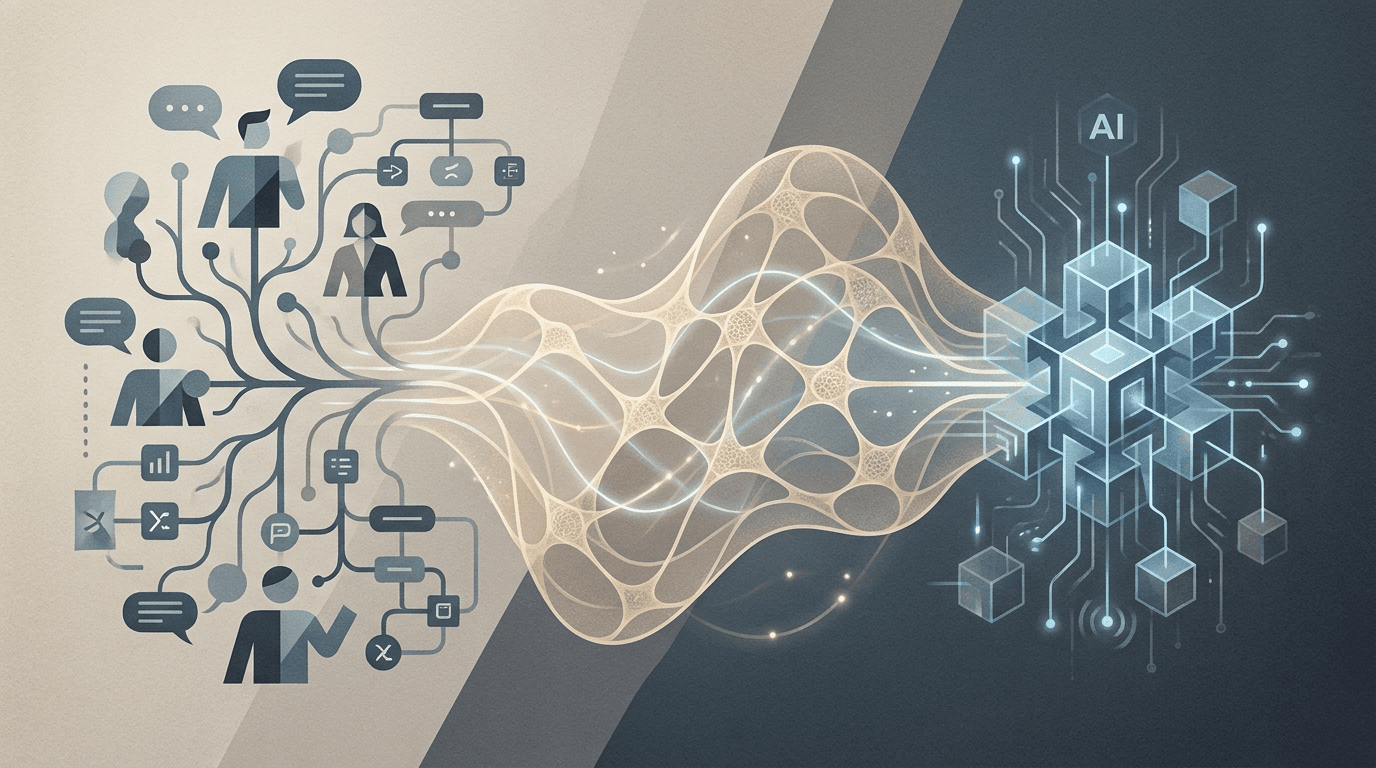
Now look at how the rest of a company creates value. How your best account manager decides which renewal to worry about. How finance decides an exception is fine this time. Why a certain client gets a phone call instead of an email. The order your ops lead sequences a launch in. That knowledge sits in people's heads, in hallway conversations, in a Slack thread from 2022. It varies from person to person and the consistency varies week to week, so it looks like it has no repeatability and no standards.
I think that's mostly an illusion. Those routines are the competitive system of a knowledge business, they've just never been written down. Nelson and Winter described routines as the genes of an organization back in 1982. Polanyi said we know more than we can tell. Walsh and Ungson wrote about organizational memory sitting in individuals, culture, and procedures, and leaving with turnover. None of this is new. What's new is that there's finally a reader that can use that knowledge if it's written down, and an organization that can't hand it over hits a ceiling.
That's the ceiling I think people are running into. You can buy every seat and every token and you'll get personal productivity gains, and then they flatten out, because the AI can only work with what the organization is able to say about itself.
Your job plus AI isn't what's happening
The framing I hear most often is the copilot. Same job, same team, same org chart, now with a helper. I understand why people like it, it's reassuring, and I don't think it describes what's going on.
I've thought of these models as a language innovation more than an automation one for a while now. Writing and the printing press both changed how people record and pass on what they know, and both times the way work got coordinated changed with it. I don't expect this round to be smaller, and the economic history points the same way.
Economists have seen a version of this before. Paul David wrote a paper in 1990 called "The Dynamo and the Computer" about why electricity took decades to show up in factory productivity numbers. Early factories swapped the steam engine for one big electric motor and kept the line shafts and the building layout. The gains came a generation later, when factories were redesigned around small motors at each machine, which changed the floor plan, the flow of work, and who did what. Brynjolfsson, Rock, and Syverson have a newer take they call the productivity J-curve, where a general purpose technology looks like it's costing you money until the investments in process, skills, and organization catch up.
I think a lot of companies are in the line-shaft phase right now. We dropped the new motor into the old building. The questions that matter look more like org design than IT. Does work still have to route through teams and hierarchies the way it did when moving information was expensive? What's a manager for when an agent can write the status report? What does a role mean when part of it is done by something that only knows what you told it? Those are conversations for leadership, for the people office, and for the teams themselves, and in most companies I talk to they haven't really started.
The stuff in people's heads is the moat
If models keep getting cheaper and more interchangeable, and they are, the thing that sets you apart is how you do business. Your judgment calls, your exceptions, the way your people handle the difficult client. Right now most of that is undocumented, ungoverned, and walking around in people's heads.
Two things follow from that, and both make me a little uneasy.
The first is that the people who carry that knowledge are about to get a lot more valuable. Personal brand matters more than it ever has, because talent that knows how the work actually gets done, and can teach a system to do it, is going to be priced very differently over the next few years. If your organization treats those people as interchangeable, they'll notice, and so will your competitors.
The second is that your way of doing business is going to be for sale. Once a routine is written down well enough for an agent to run it, it's portable. A competitor can hire the person who knows it, or a vendor can package the pattern and sell it to your whole industry. If you haven't captured it and governed it, you can't protect it, and you won't even be able to tell what you lost.
What I've seen when it moves
I'll stick to what I've seen myself, and it's early. In one PE-backed mid-market transformation I've been running, about three months in, we've seen roughly three points of margin and close to double the revenue per head with the same team. That's one engagement and not a benchmark. Inside my own company, running on a governed shared knowledge base, token costs dropped more than threefold while the team stayed the same size.
In both cases most of the work wasn't the tooling. It was writing down how the work actually gets done, versioning it, deciding who gets to change it, and then letting people and agents work from the same source. A lot of it was conversations, some of them uncomfortable, about who decides what and why.
Two outcomes
I keep ending up in the same place. At some point at least one of your competitors is going to do this work. They'll capture how they operate, govern it, and rebuild their teams around it, and they'll be running on a different cost model than you. At that point the gap isn't about AI maturity anymore, it's about what it costs each of you to serve the same customer.
So I think there are two paths. One is looking at this change directly, with some earnest leadership, and having the conversations about org design, roles, and how knowledge moves through the company. Your people team becomes one of your most strategic partners in that, and you put real effort into some system to codify the work and govern it. It's slow and hard and mostly not about technology.
The other is that somebody else does it first.
Here's the hypothesis I want to test, and I'd like to hear from anyone with data either way. I think the companies that get out of pilot purgatory won't be the ones with the best models or the most agents. They'll be the ones that got their undocumented routines written down and governed before their competitors did, and redesigned their teams around them. If that's right, the most important AI decisions of the next two years get made with the people office in the room, not just IT.
Sources
- MIT NANDA, "The GenAI Divide: State of AI in Business 2025," coverage via The Register (2025)
- BCG, "The Widening AI Value Gap" (2025), summary via Lewis Silkin
- McKinsey, "The state of AI in 2025: Agents, innovation, and transformation"
- Paul A. David, "The Dynamo and the Computer: An Historical Perspective on the Modern Productivity Paradox," American Economic Review 80(2), 1990
- Erik Brynjolfsson, Daniel Rock, and Chad Syverson, "The Productivity J-Curve: How Intangibles Complement General Purpose Technologies," American Economic Journal: Macroeconomics 13(1), 2021
- Richard R. Nelson and Sidney G. Winter, An Evolutionary Theory of Economic Change, Harvard University Press, 1982
- Michael Polanyi, The Tacit Dimension, University of Chicago Press, 1966
- James P. Walsh and Gerardo Rivera Ungson, "Organizational Memory," Academy of Management Review 16(1), 1991
Get insights like this delivered
Join leaders navigating AI governance and agentic systems.